
Night Shift Support Maturity Model
A four-level maturity model for assessing night-shift visibility, policies, targeted supports, work design, and organizational progress.
A shared language for assessing night shift support
An organization may operate around the clock while its services, communication, and employee support still follow a daytime schedule. The Night Shift Support Maturity Model gives employers a way to examine that gap and discuss what needs to change.
Inside this resource
- Four levels of support
- Five assessment questions
- Guidance for moving between levels
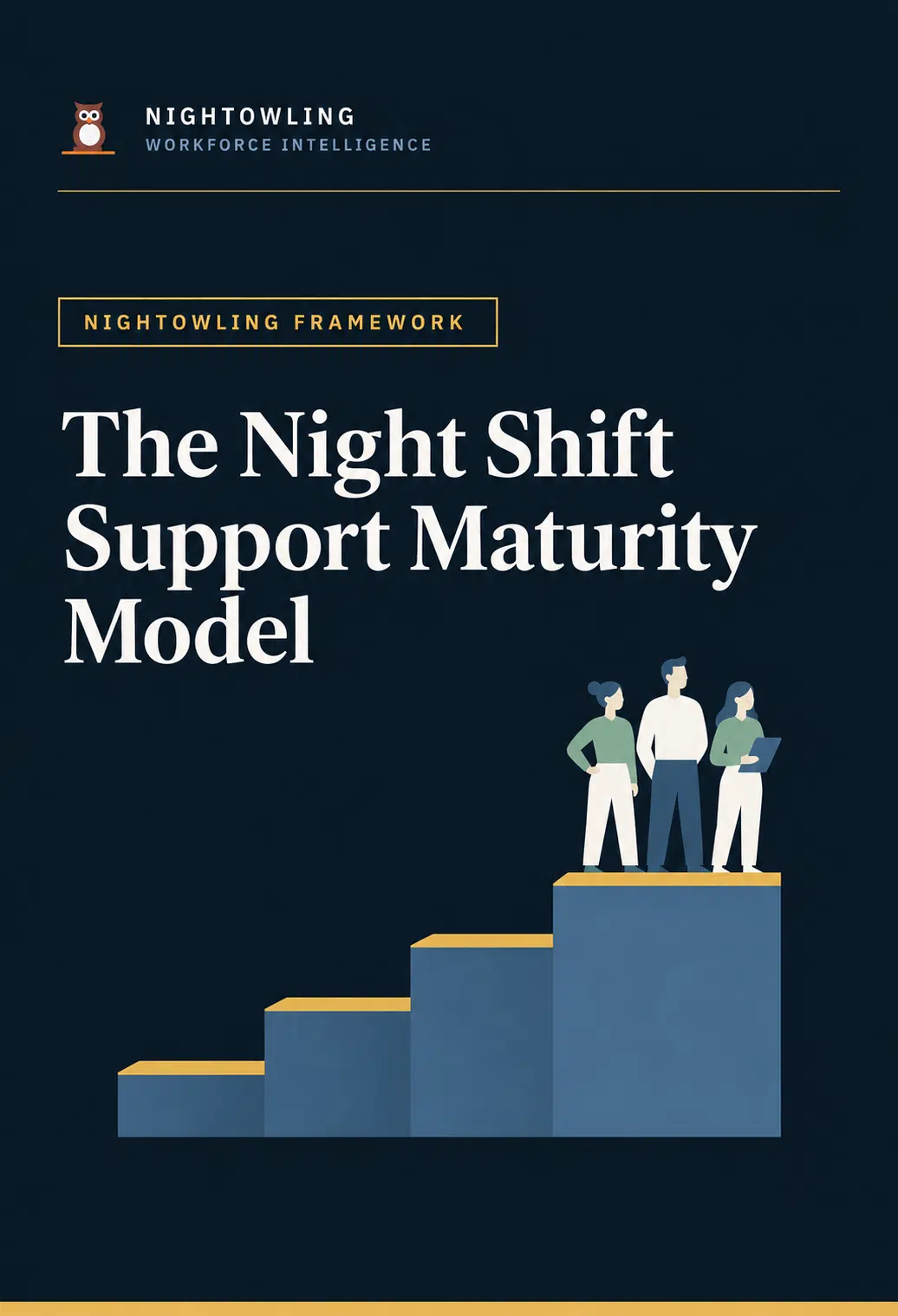
It describes four levels, from night workers being largely invisible in organizational systems to their needs being considered in work design and leadership decisions. Five questions help a team locate its current position and choose a next step.
This is a NightOwling framework for self-assessment and discussion. Employers, workforce leaders, and partners can use it to scope priorities and explain why an improvement is needed.
The four levels in the framework
Level 0 Invisible
The organization has limited visibility of who works nights. Services and support mainly operate during daytime hours, and night staff’s experience is difficult to distinguish in the available records.
Level 1 Compliant
Hours, staffing requirements, and policies receive attention, but the review remains focused on documentation. Incident and workforce records may exist without being examined by shift.
Level 2 Supported
The organization identifies its night workforce and introduces targeted support. Examples include accessible food, supervisor preparation, sleep education, clearer schedules, and services available during night workers’ waking hours.
Level 3 Designed
Night work is considered across schedules, transitions, management, training, communication, and employee services. Leaders can see night-specific information and use it when making decisions.
Five questions and guidance for the next step
The self-assessment asks whether your systems can identify night workers; whether incidents, turnover, and absence are reviewed by shift; whether support works during the hours night staff need it; whether schedules and transitions account for circadian evidence; and whether night-shift information reaches executive review.
The progression guidance starts with making the workforce visible, moves into targeted support, and then examines how night work is built into organizational decisions. Use the questions with examples from your own operation so the discussion ends with a specific gap and a person responsible for reviewing it.
One available service does not describe the whole night-shift experience
An organization might extend food service while training remains difficult to attend. It might know who works nights but still combine their absence and turnover with daytime figures. Those differences matter when deciding where to act next.
Use the model to examine the evidence behind a level. Ask which teams and locations an arrangement reaches, what remains unavailable, and what leaders can actually see. The next improvement may require a different owner from the one responsible for the service already in place.
Questions about this framework
Where should we start with the self-assessment?
Bring together people who can describe the night operation and the services around it. Start with the five questions, using your roster, existing records, and examples of what staff can access. Record where the evidence is missing or differs between teams, then use the progression guidance to choose a gap to investigate.
Does the Compliant level establish legal compliance?
No. “Compliant” is the framework’s label for a posture centered on documented requirements and policies. The model does not audit applicable laws, contracts, accreditation requirements, or local operating procedures.
How does it relate to the Support Gap Index?
The maturity model describes a progression in organizational support. State of the Night Shift uses the Support Gap Index to examine external pressures across support domains. The framework provides a shared reference for discussing the organizational response; it is not the same assessment as the report’s index.
Can we use it if departments are at different levels?
Yes. Discuss the evidence separately for the relevant departments, roles, or sites before making a broader judgment. Record where access or management arrangements differ, then use the progression guidance to choose the next gap to address.
Read the full framework
Use the complete level descriptions, five assessment questions, and progression guidance to structure a conversation with your team.
Build support around your night workforce
Talk with NightOwling about a program and resources shaped around your workforce, operating conditions, and priorities.
