
How Employers Can Support Nutrition and Overnight Food Access
An employer guide to improving overnight food access and creating conditions that make practical, nourishing choices possible during night shifts.
Workplace nutrition that reaches night shift teams
Food provision needs to work at the time and place someone can use it. A daytime cafeteria, a distant refrigerator, or a delivery arriving outside the break window can leave night staff with little usable choice.
Inside this resource
- 14 sections
- Overnight access standard
- 90-day starting plan
This employer guide sets out how to examine and improve those conditions. Across 14 sections, it covers break coverage, water and facilities, overnight food options, vendor standards, price, workforce inclusion, manager expectations, and evaluation.
It is written for employers, managers, operations, facilities, procurement, food-service teams, and people responsible for a workforce that continues overnight. Its 90-day starting plan helps a local team define a problem, test a manageable improvement, and review whether staff can actually use it.
What the employer food-access guide covers
See what is available during the actual shift
Compare policy with the route workers take to a break, water, storage, food, and a place to eat. Include deep-night hours, weekends, overtime, and different departments. Use the findings to define a minimum standard with clear owners and response arrangements.
Make breaks and food facilities usable
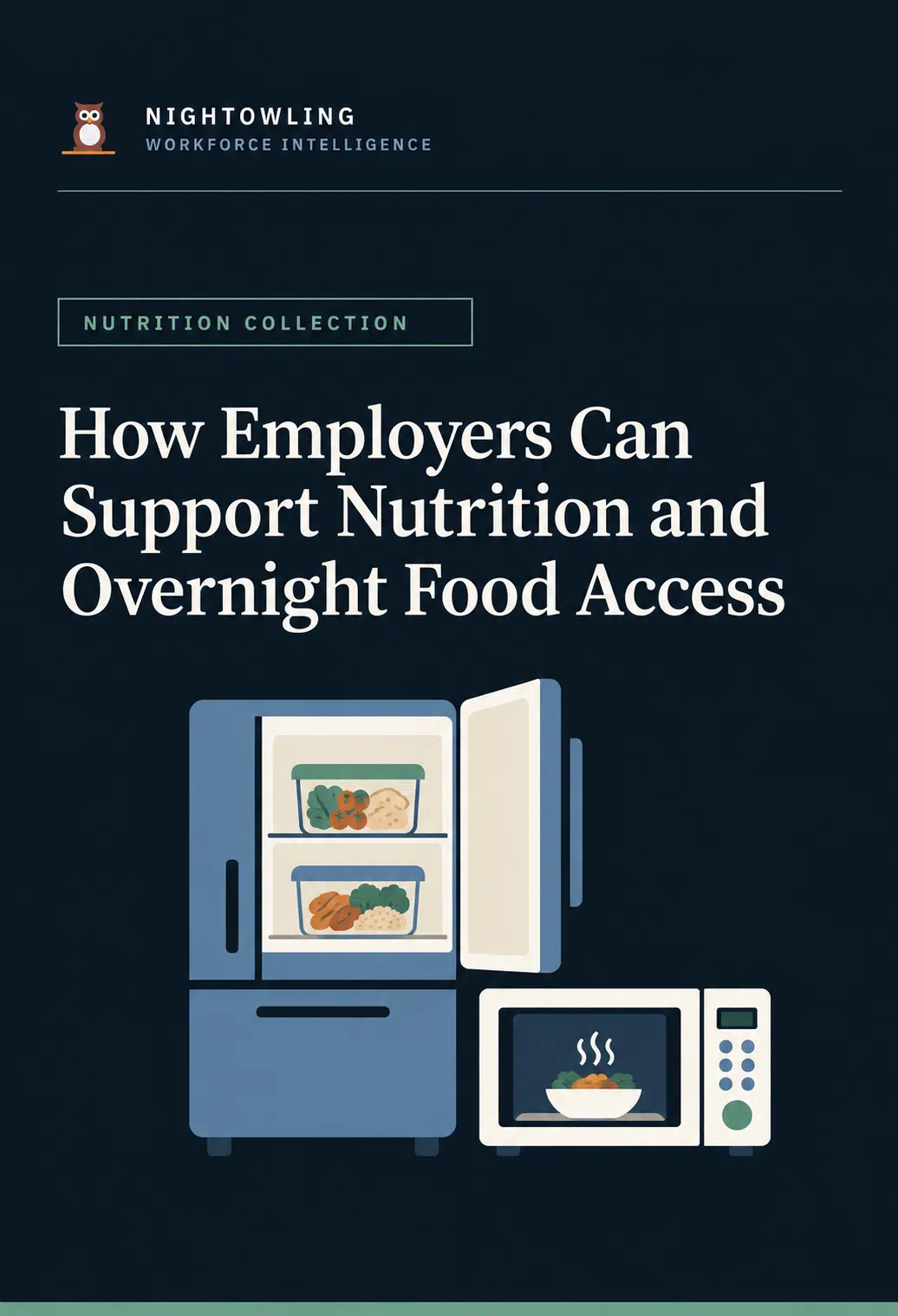
Review relief coverage, interrupted breaks, walking time, refrigerator capacity, microwave queues, cleaning, repairs, and backup arrangements. The guide treats packed food and purchased food as equally dependent on a workable setting.
Choose and maintain overnight food provision
Consider staffed service, replenished grab-and-go food, micro-markets, lockers, vending, pre-ordering, and mobile delivery according to site needs. Define hours, stock, range, ingredient information, price, and failure response in the vendor arrangement. Include contractors, temporary teams, and employees with different food preferences and needs.
Give managers and workers clear information
Set expectations for protecting breaks and reporting repeated failures. Explain locations, opening hours, payment methods, eligibility, and what happens when access fails. Adapt arrangements for mobile, remote, and hot work, with the relevant local professional review.
Evaluate access and sustain what works
Review break opportunities, stockouts, price differences, equipment uptime, queues, and anonymous worker accounts. The guide’s phased start moves from checking and repairing the basics to a limited trial and follow-up. Evaluation focuses on the workplace system while protecting personal food and health information.
A 90-day starting plan and standards to take into the review
The guide provides a sequence a local team can adapt to its authority, resources, and operating conditions. The 90-day plan is an implementation example within the publication.
- Days 1–30: establish the actual conditions: Assign owners, walk the night operation, compare the written arrangements with what workers experience, correct basic failures, and establish a baseline.
- Days 31–60: test a defined change: Pilot one break improvement and one food-access improvement. Set product, price, replenishment, and response standards, prepare managers, and ask workers whether access is usable.
- Days 61–90: review and embed: Compare with the baseline, check who remains excluded and whether burdens moved elsewhere, then decide what to continue, change, or stop.
- Vendor and access review material: Use the minimum-access list, vendor-contract table, manager scenarios, and system measures to make responsibilities and follow-up specific.
Measure what remains available when the break finally happens
A food service can meet its advertised hours and still miss most of the night team. The guide gives an illustrative problem: a grab-and-go unit is empty by 2 a.m. on weekends, while the relief plan fails whenever more than one person is absent. More posters about healthy eating would leave both conditions unchanged.
That finding needs two owners and two responses. Food service or procurement can examine replenishment and quantities; operations can review coverage and the backup arrangement. The follow-up should ask whether suitable food remains available at the times workers can actually stop.
CDC’s guidance on food-service policies and contracts supports defining vendor requirements, reporting, compliance checks, and responsibilities. This guide applies that approach to overnight hours, including the affordability and location of the options provided.
System records and anonymous feedback can show whether access improved. Individual food logs, named purchases, and weight measurements are not needed to establish whether the refrigerator worked or the meal break happened.
Questions about this guide
How can employers improve workplace nutrition for night shift staff?
Start by checking what staff can use during the actual night shift: meal-break coverage, water, storage, reheating, food availability and price. Use the guide to set a minimum access standard, assign owners and test one defined improvement. Where an employee meal program is part of the response, the guide helps with provision and vendor decisions; it does not provide a meal-ordering or benefits-administration service.
Do we need to keep a staffed cafeteria open all night?
The guide describes alternatives including replenished grab-and-go units, meal lockers, vending, pre-ordering, and mobile provision. Choose around actual break patterns, locations, demand, dietary range, and maintenance capacity. A smaller service still needs dependable stock and a response when equipment or delivery fails.
What if most employees already bring their own food?
Check whether they can store, reheat, and eat it safely during a usable break. Refrigerator capacity, microwave queues, walking distance, cleaning, and equipment failures can make packed food difficult to use. The guide includes those facilities in the access review alongside purchased options.
How should we measure whether an improvement is working?
Compare the access problem before and after the change. Useful measures include missed breaks, stockouts by time, price parity, equipment uptime, queue time, and anonymous reports of usable access. Check different shifts, locations, and contract groups while protecting privacy. Do not claim health or productivity outcomes that the evaluation did not establish.
Can this sit within our existing workforce or food-service program?
Yes. Use the review to identify where current arrangements fail overnight, then assign changes to the team with authority over coverage, facilities, vendor terms, or communication. Apply the plan with the local occupational health, food safety, human resources, and other professional review relevant to the decisions.
Read the full guide
Use the complete employer guide to review overnight provision, facilities, breaks, vendor arrangements, and follow-through.
Build support around your night workforce
Talk with NightOwling about a program and resources shaped around your workforce, operating conditions, and priorities.
