
Night Shift Nurse Sleep Schedule: How to Get Enough Rest Between Shifts
TL;DR: Aim to be in bed by 8:30am on workdays. Earlier is better. Waiting past 10am shortens your total sleep. Budget 45 to 60 minutes after shift end for charting overrun and the commute home before your sleep window starts. After high-acuity or emotionally difficult nights, a 20-minute decompression routine cuts cortisol and shortens sleep…

The best night shift nurse sleep schedule for a 7pm to 7am shift is to be in bed by 8:30am and awake by 4:00pm. That 7.5-hour anchor protects your sleep during the window when your body is biologically primed to sleep after a full night of work. After a high-acuity night with a code or a difficult patient, build in 20 to 30 minutes of decompression time before bed or your cortisol will keep you from falling asleep.
Why Standard Sleep Advice Doesn’t Fully Apply to Nurses
A true night shift nurse sleep schedule has to account for realities that generic advice ignores. General night shift sleep advice assumes your shift ends cleanly at 7am. Hospital nursing rarely works that way. Night shifts end at 7am on paper. In practice, handoff report runs long, a patient deteriorates at 6:45am, or your documentation catches up with you. Most night shift nurses leave the building between 7:30am and 8:00am on a typical shift. After a busy night, it can be 8:30am or later.
That real-world exit time compresses your sleep window. If you subtract a 30-minute commute and 30 minutes of wind-down, a nurse who walks out at 8:00am may not be in bed until 9:00am. That already cuts into a full 7-hour block before your 4:30pm wake-up target.
Nursing also differs from other overnight work in another key way: emotional residue. ICU codes, traumatic admissions, and grief conversations keep the nervous system activated long after the shift ends. Research in BMC Nursing found that night shift stress directly increases sleep disturbance in nurses, with the effect mediated through elevated cortisol. A shift that felt manageable mentally can still spike cortisol enough to delay sleep onset by 30 to 60 minutes.
A night shift nurse sleep schedule built for nurses needs to account for both of these realities: the actual exit time from the hospital, and the physiological cost of high-acuity care.
Night Shift Nurse Schedule: Standard 7pm to 7am (Post-Shift Sleep)
This schedule is for nurses working a 7pm to 7am shift who can get home within 30 to 45 minutes and who fall asleep within 30 minutes. It builds in the real departure time most nurses experience.
| Time | Activity |
|---|---|
| 5:30pm | Wake up. Eat a full pre-shift meal. Protein and complex carbohydrates. |
| 6:00pm | Get ready. Avoid bright phone screens in the last 30 minutes before leaving. |
| 6:45pm | Commute to hospital. |
| 7:00pm | Shift starts. Receive handoff from day shift. Patient assessments begin. |
| 3:00am | Alertness dip. Take a break. Eat a light protein snack. Walk the hallway. |
| 6:30am | Begin documentation wrap-up. Start handoff prep. |
| 7:00am | Give report. Shift handoff begins. |
| 7:30am | Finish any remaining charting. Leave building. Blue-blocking glasses on. |
| 8:00am | Arrive home. Light snack if hungry. Dim all lights inside. |
| 8:15am | Decompression window (if needed): 15 to 20 minutes of quiet activity. No screens. See section below. |
| 8:30am | Wind-down: cool shower, blackout curtains closed, room cooled to 65 to 67°F. |
| 9:00am | In bed. Target sleep. |
| 4:00pm | Wake up (7-hour block). |
| 4:30pm | Eat main meal. Light movement. Prepare mentally and physically for next shift. |
| 5:30pm | Repeat. |
Why 9:00am and not 8:30am: This night shift nurse sleep schedule uses a realistic 7:30am departure instead of the theoretical 7:00am end time. Most experienced night nurses know they are rarely out the door at 7:00am sharp. Building that buffer into the schedule removes the stress of “running late to sleep” on busy nights.
What to Do After a High-Acuity Night: The Decompression Window
After a code, a difficult family conversation, or a patient who deteriorated rapidly, your body’s stress response system stays active. Night shift work activates the hypothalamic-pituitary-adrenal axis, and research in Frontiers identified elevated morning cortisol as a direct pathway to sleep disruption in night shift nurses. You cannot fall asleep normally with cortisol still running high. Trying to force sleep in that state means lying awake for 45 minutes instead of drifting off in 15.
A short, structured decompression window between leaving the hospital and attempting sleep dramatically shortens sleep onset on difficult nights.
15 to 20-minute decompression routine for post-acuity nights:
- Physical reset. Tense every major muscle group for 5 seconds, then release. Repeat twice. This is not exercise. It is a nervous system reset technique that signals the body to move from fight-or-flight to rest.
- Verbal processing. Say out loud what happened and what you did well. Brief and specific. This is not rumination. It is a closing ritual that tells your brain the event is over.
- Controlled breathing. Four counts in, hold four, out for six. Repeat six times. This activates the parasympathetic nervous system and reduces cortisol faster than distraction.
- No debrief on the phone. Save longer conversations with colleagues or partners for after you wake up. Replaying the shift in detail before sleep increases arousal, not resolution.
After the 15 to 20 minutes, proceed to your normal wind-down. The goal is not to process everything. The goal is to lower cortisol enough to let sleep begin.
3-On/4-Off Nursing Schedule: Full Sleep Strategy
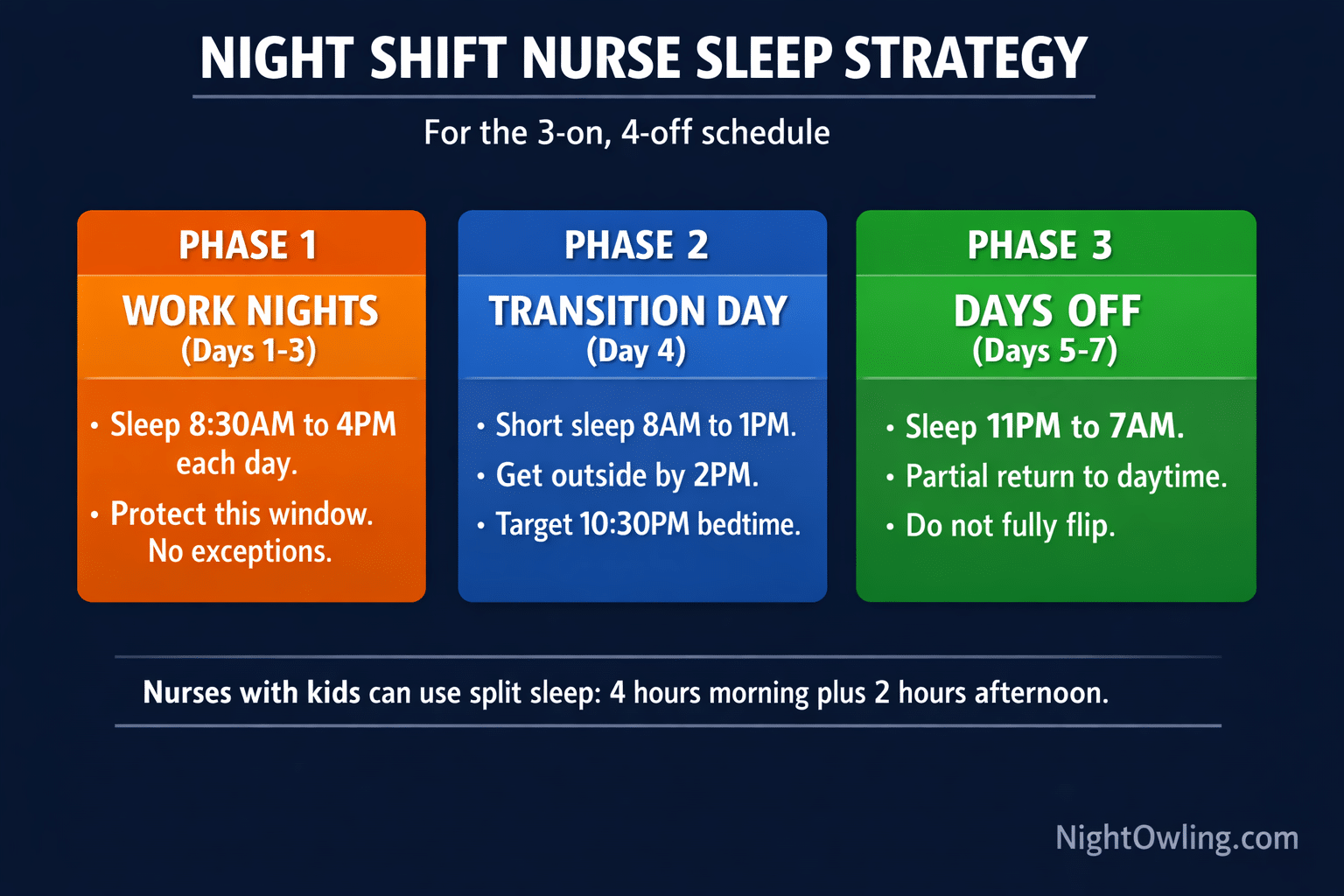
The 3-on/4-off schedule is the most common shift pattern in U.S. hospital nursing. Three consecutive 12-hour nights, followed by four days off. This pattern works well for a night shift nurse sleep schedule when you treat the four off days as a structured circadian reset rather than a free-for-all.
During Your Three Work Nights
Hold the same sleep window every workday. Bed by 8:30am to 9:00am. Wake between 3:30pm and 4:00pm. Consistency across all three workdays reduces cumulative fatigue because your body stops fighting the schedule and begins to align with it.
The Morning After Your Last Night Shift (Transition Day)
This is the day most nurses handle badly. You are exhausted but also eager to reclaim normal life. The temptation is to sleep until 7pm, which then wrecks your schedule for the next 48 hours.
The controlled approach:
| Time | Activity |
|---|---|
| 7:30am | Arrive home after final shift. Light meal. Dim lights. |
| 8:00am | Sleep begins. |
| 1:00pm | Wake up (5-hour block). Set an alarm. Do not sleep through. |
| 1:30pm | Get outside. Natural daylight exposure helps shift your circadian clock forward. |
| 5:00pm | Light physical activity. A walk or easy exercise is enough. |
| 9:30pm | Wind-down routine begins. |
| 11:00pm | Target bedtime. |
| 7:00am | Wake up (first day off, daytime mode). |
The 5-hour cap on transition day sleep is deliberate. It leaves enough sleep pressure to fall asleep at 11pm or midnight, which re-anchors you to a near-normal schedule without requiring a full flip.
Days Off 1 and 2: Partial Shift Back
After transition day, you have rebuilt enough of a daytime schedule to function. Two practical options:
- Option A: Full return to daytime. Go to bed around 11pm, wake between 7am and 9am. Use both days to run normal-life tasks, maintain social connection, and get outdoor light in the morning. This works well for nurses with families, social commitments, or daytime appointments stacked on their days off.
- Option B: Partial hold. Sleep from 3am to 11am or midnight to 8am. This is a compromise that preserves some of the night-shift alignment while still allowing evening social time. It works better when your days off are short (two days) and you need to return to nights without re-adapting completely.
The Day Before Returning to Night Shift
| Time | Activity |
|---|---|
| Wake up by 10am | Last day of days off. Use morning light to stay anchored. |
| 2:00pm | Pre-shift nap of 90 to 120 minutes. Set an alarm. |
| 4:00pm | Wake from nap. Eat a full meal. |
| 6:45pm | Head to work. |
| 7:00pm | First night shift resumes. |
The pre-return nap is supported by ANA research, which identifies scheduled naps before returning to night shifts as a key alertness strategy. It reduces the drag of the first night back without disrupting the return to a night shift nurse sleep schedule.
Split Sleep Schedule for Night Shift Nurses with Kids
Nurses with school-age or young children face a structural problem: the people who need them awake are active during the same hours they need to sleep. A single 7-hour morning block is not realistic if you need to pick up a child from school at 2:30pm or manage morning drop-off.

The split sleep model addresses this directly. It divides the total sleep into two blocks with a functional window in between.
Split Sleep: Nurse with School-Age Kids
This night shift nurse sleep schedule assumes a child who leaves for school before 8:30am and returns around 3:00pm.
| Time | Activity |
|---|---|
| 7:30am | Home from shift. Morning routine with family if kids are awake. Light, brief interaction only. |
| 8:30am | Kids at school. First sleep block begins. Blackout curtains, white noise on. |
| 1:00pm | Wake up (4.5-hour block). Eat, handle quick errands or tasks. |
| 2:45pm | School pickup. Active time with kids: homework, snack, outdoor time. |
| 5:00pm | Second sleep block begins. Kids can watch TV or do homework independently. |
| 6:30pm | Wake up (1.5-hour block). Total sleep: 6 hours. |
| 7:00pm | Family dinner or brief family time. |
| 9:00pm | Shift prep. Leave by 6:30pm for 7pm shift start. |
On workday nights: Arrange evening coverage (partner, family member, trusted sitter) from 6:30pm until school pickup the following afternoon. This is the real structural need for nursing parents: not a unique sleep trick, but a reliable handoff person.
Split Sleep: Nurse with Infant or Toddler
Infants and toddlers cannot self-supervise. This schedule requires a caregiver for all sleep blocks.
| Time | Activity |
|---|---|
| 7:30am | Home. Hand off child to partner, parent, or caregiver. |
| 8:00am | First sleep block begins. |
| 12:30pm | Wake up (4.5-hour block). Brief time with child while caregiver stays present. |
| 1:30pm | Caregiver takes over again. Second sleep block begins. |
| 3:00pm | Wake up (1.5-hour block). Total sleep: 6 hours. |
| 3:00pm to 6:30pm | Active time with child. |
| 6:30pm | Leave for shift. Caregiver stays overnight. |
The minimum requirement here is 6 hours of total protected sleep across the two blocks. Dropping below 6 hours consistently creates cumulative sleep debt that compounds across a 3-night stretch. Research in Health Sciences found that sleep-deprived nurses had significantly higher medical error rates at every shift length compared to non-sleep-deprived nurses. Protecting your night shift nurse sleep schedule is a patient safety practice.
7am to 7pm Day Shift Rotation: When You Alternate Between Days and Nights
Some hospitals still schedule rotating shifts, alternating nurses between day (7am to 7pm) and night (7pm to 7am) blocks. This is the hardest schedule pattern for sleep because it never allows full circadian adaptation.
If you rotate, the goal is to minimize the speed of the reversal. Moving from night shift to day shift in fewer than 48 hours is a full circadian sprint. The minimum viable strategy:
Rotating to day shift (last night shift to first day shift):
| Day | Sleep Strategy |
|---|---|
| Final night shift morning | Sleep from 8am to 1pm only. Limit to 5 hours. |
| That afternoon | Stay awake. Use afternoon light exposure. Target sleep at 10pm. |
| Night before first day shift | Asleep by 10pm. Wake at 5:30am for 7am day shift start. |
This is not comfortable. It requires significant sleep pressure management across 36 hours. The ANA night shift guide recommends requesting clustered shifts over rotating shifts where possible, specifically because rotation prevents the body from adapting and consistently produces worse sleep outcomes than either permanent nights or permanent days.
If you have scheduling flexibility, clumping night shifts together is always better for sleep quality than spreading them across the week with rotation days in between.
Schedule Comparison: Which Pattern Works for Each Situation
| Nurse Situation | Recommended Sleep Pattern | Target Bedtime | Target Wake Time |
|---|---|---|---|
| Standard 3-on/4-off, no kids | Consolidated block | 8:30 to 9:00am | 3:30 to 4:00pm |
| 3-on/4-off, school-age kids | Split (4.5 hr + 1.5 hr) | 8:30am / 5:00pm | 1:00pm / 6:30pm |
| 3-on/4-off, infant/toddler | Split with full caregiver | 8:00am / 1:30pm | 12:30pm / 3:00pm |
| Post-high-acuity night | Consolidated with decompression buffer | 9:00am | 4:00pm |
| Transition day (last night to days off) | Short block (5 hr) + normal night | 8:00am | 1:00pm |
| Rotating day/night | Partial reversal (5 hr cap, daylight exposure) | 10:00pm pre-day shift | 5:30am |
| Day before returning to nights | Full rest + pre-shift nap (90 min) | Prior night: 11pm | Day of: 10am + nap at 2pm |
Sleep Environment Essentials for Daytime Nursing Sleep
Daytime sleep is structurally harder than nighttime sleep. Light and noise levels are higher, and your circadian clock is signaling wakefulness. Two things matter most for any night shift nurse sleep schedule.
- Darkness. Blackout curtains are the single highest-value purchase for any night shift nurse. Light suppresses melatonin and triggers early waking. Even small gaps around window edges interrupt sleep. Use blackout curtains plus a sleep mask. This is not optional. Product examples: Basic sleep mask from Amazon, Manta Sleep Mask. (Use the linked Manta product page and code NIGHTOWLING at checkout for 10% off Manta Sleep products.)
- Sound masking. Hospital neighborhoods are active during the day. A white noise machine, box fan, or sleep app running at moderate volume prevents the sharp acoustic events (deliveries, lawnmowers, construction) that pull you out of light sleep before you reach restorative deep sleep.
- Room temperature. Keep your sleep room between 65 and 67°F. Sleep science consistently identifies this range as optimal for sleep onset and deep sleep maintenance. A programmable thermostat set to drop to this range before your target bedtime handles this automatically.
For the full evidence base on circadian disruption and recovery in night shift workers, see the NightOwling research library.
FAQs: Night Shift Nurse Sleep Schedule
When should a night shift nurse sleep after a 7pm to 7am shift?
The target window is in bed between 8:30am and 9:00am, after accounting for charting time, handoff, and commute. Aim to be home and dimming lights by 8:00am. Waiting until 10am or later shortens total sleep significantly and makes the 4:00pm wake-up harder. On a standard night, a 9:00am bedtime and 4:00pm wake-up provides 7 hours, which is the minimum recommended by the National Sleep Foundation.
What is the best night shift nurse sleep schedule for a 3-on/4-off nurse?
The best night shift nurse sleep schedule for this pattern holds the same sleep window across all three work nights: in bed by 8:30am to 9:00am, awake by 3:30pm to 4:00pm. On the morning after your last shift, cap sleep at 5 hours to avoid wrecking your days-off schedule. Use the first two days off to shift your sleep window earlier by 2 to 3 hours per day. Pre-nap 90 minutes on the afternoon before returning to your first night shift.
How can a night shift nurse sleep when they can’t wind down after a hard shift?
Hard or traumatic shifts trigger cortisol elevation that delays sleep onset. A structured 15 to 20-minute decompression routine before bed lowers cortisol faster than distraction. The sequence: physical muscle tension-and-release, brief verbal processing out loud, then controlled breathing (4-count in, 4-count hold, 6-count out). Avoid replaying events in detail on the phone. That reinforces arousal instead of closing it.
How do night shift nurses with kids get enough sleep?
The most reliable model is split sleep: a 4 to 5-hour block after arriving home, followed by a 1 to 1.5-hour nap after school pickup or after handing off child care to another adult. This provides 5.5 to 6.5 total hours, which is below ideal but workable on workdays. Sustainable nursing parent schedules depend on having a reliable caregiver for the evening shift start and the overnight period.
Should a night shift nurse keep a night schedule on days off?
For nurses with short days off (two days or fewer), holding the night-shift sleep window is the most effective strategy. Flip-flopping to a full daytime schedule and back forces two complete circadian reversals per week, which compounds fatigue and increases error risk on return nights. For nurses with four or more days off, a partial drift toward daytime hours is manageable: shift bedtime 2 to 3 hours earlier each day rather than jumping immediately to a full daytime schedule.
Build a Schedule That Works Beyond This Week
The schedules above give you a tested framework for 12-hour nursing nights. Consistency matters more than perfection. A night shift nurse sleep schedule you follow reliably on six of seven workdays outperforms an ideal schedule you abandon after one hard night.
Track your sleep across a full 3-on/4-off cycle. Note which nights you feel best and worst, when you fall asleep fastest, and what disrupts your rest. That data tells you more about your individual sleep needs than any generic recommendation.
Tracking your own data is the best way to refine your night shift nurse sleep schedule over time. For the full science behind circadian adaptation, light management, and long-term night shift health, read the night shift sleep guide. For everything specific to the nursing profession, including fatigue data, patient safety research, and career considerations, visit the night shift nursing guide. For general 12-hour shift sleep templates you can adapt, see the 12-hour sleep schedule post.
If you want personalized guidance for your specific shift pattern and home situation, explore what NightOwling offers for individual night shift workers at NightOwling for Individuals.
Sources: BMC Nursing | Frontiers in Public Health | Current Health Sciences Journal | American Nurses Association | Acta Clinica Croatica | National Sleep Foundation
![Photo of [object Object] in undefined](https://nightowling.com/wp-content/uploads/2025/12/image-6.png.webp)
