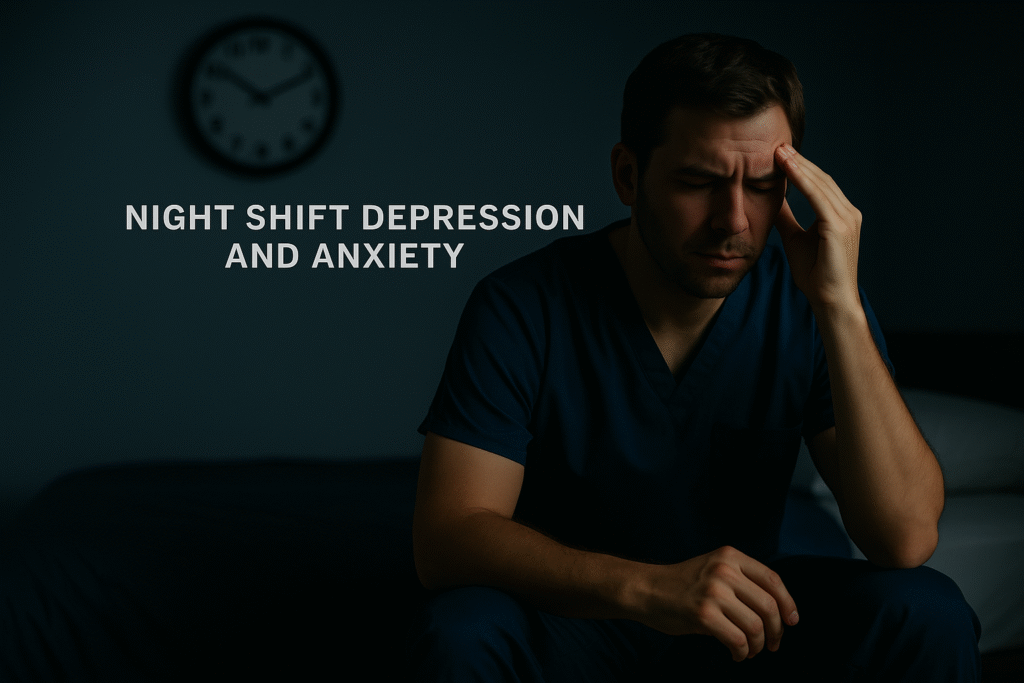
The Hidden Cost of Night Shift Fatigue and Why It May Not Show Up on Your Spreadsheet
While night shift labor costs look predictable on a spreadsheet, cumulative fatigue creates a ‘shadow tax’ that drains millions in productivity and retention. We examine the three hidden dimensions of fatigue-related ROI and show C-suite leaders how to turn 24/7 operational risks into a competitive advantage.

In the modern global economy, the 24-hour cycle is no longer an outlier; it is the standard. For leaders in Finance, HR, and Operations, the “always-on” model is a logistical necessity to meet demand and maximize capital assets. However, as organizations scale their night-shift operations, a silent predator often goes unnoticed in the quarterly reviews: Cumulative Shift Fatigue.
On a balance sheet, labor costs are predictable. You see the night shift differential, the overtime hours, and the headcount. What you don’t see—and what often costs organizations millions in leakage—is the “shadow tax” of a fatigued workforce.
To build a true business case for night-shift optimization, we must look beyond the visible payroll and examine the three hidden dimensions of fatigue-related ROI.
1. The “Presenteeism” Leakage: Productivity Beyond Headcount
For Finance and Operations leaders, productivity is often measured by output per man-hour. However, fatigue introduces a phenomenon known as Presenteeism—where employees are physically clocked in but cognitively absent.
Research suggests that the cognitive impairment caused by 17–19 hours of wakefulness is equivalent to a blood alcohol concentration (BAC) of 0.05%. By the end of a grueling night-shift rotation, that impairment can rise to 0.10%.
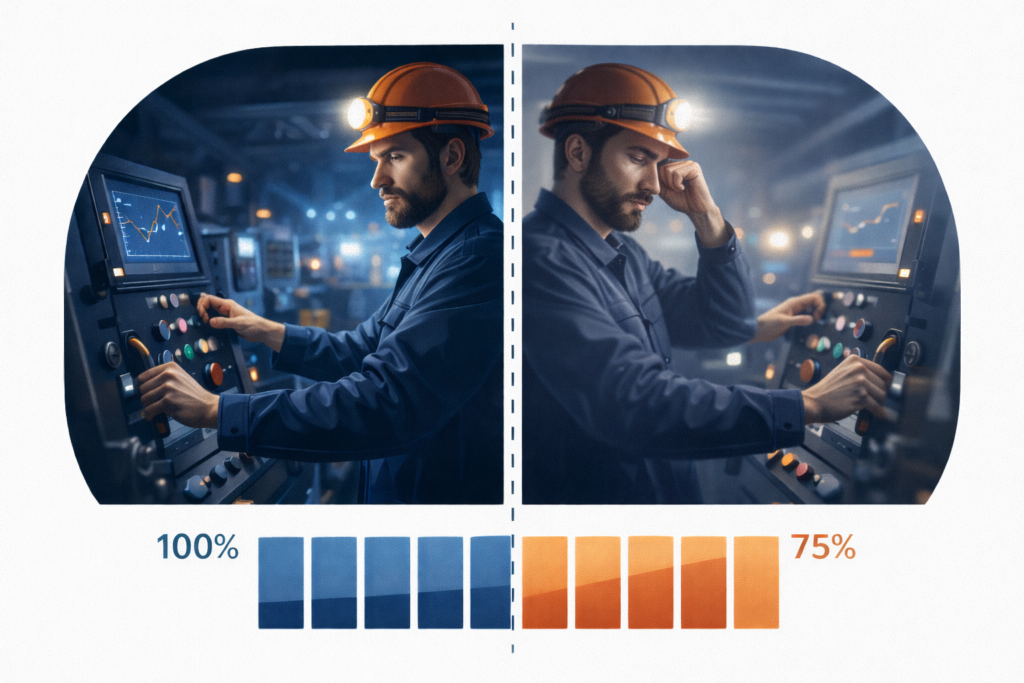
The Spreadsheet Reality: You are paying 100% of the wage for roughly 70-80% of the cognitive capacity. This manifest as:
- Slower processing times in logistics.
- Increased “re-work” and quality control errors.
- Degraded decision-making in high-stakes environments.
The ROI Opportunity: By implementing NightOwling’s circadian-aligned strategies, organizations can reclaim these “lost hours,” effectively increasing throughput without increasing headcount.
2. The Retention Crisis: The $15,000–$25,000 Per-Head Cost
HR leaders are currently battling a historic talent shortage. In the 24/7 industrial and service sectors, turnover is notoriously high. When an employee leaves due to burnout or the inability to manage the night-shift lifestyle, the cost isn’t just a job posting.
The Society for Human Resource Management (SHRM) estimates that replacing an employee costs 6 to 9 months of their salary on average. For a specialized night-shift worker, this includes:
- Separation costs: Exit interviews and administrative time.
- Training costs: The loss of institutional knowledge.
- Ramping costs: The period where a new hire is less than 100% productive.
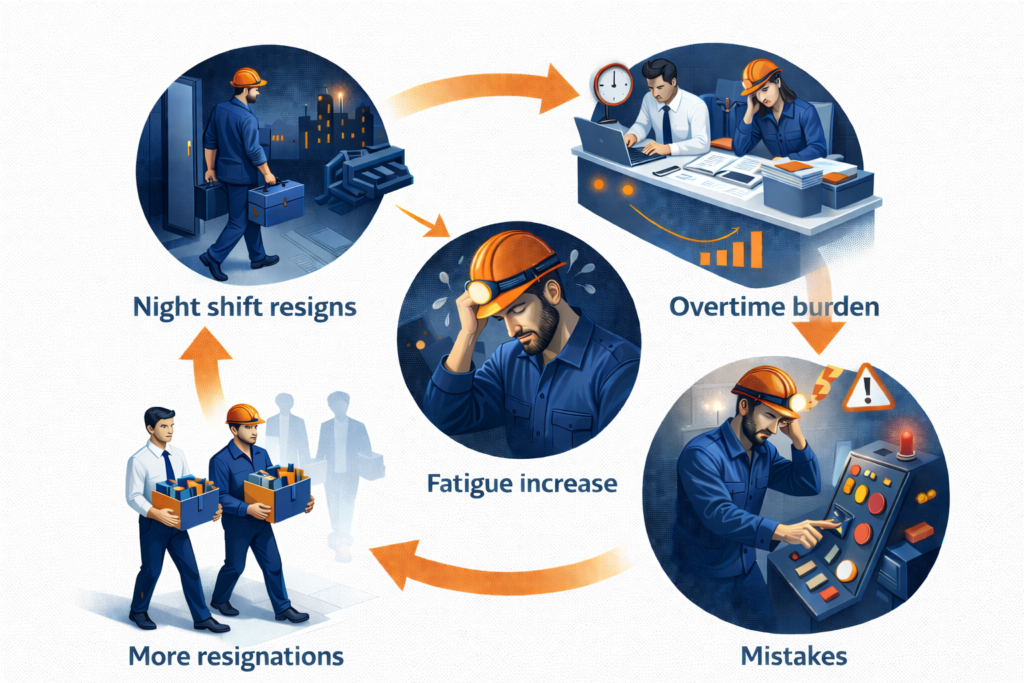
The Hidden Cost: Frequent turnover creates a “fatigue loop.” When one person leaves, the remaining staff must cover the gap through overtime, which increases their fatigue, leading to more turnover.
The ROI Opportunity: Investing in the well-being and biological support of night-shift workers isn’t just a “perk”—it is a retention strategy. Reducing turnover by even 10% can save a mid-sized operation hundreds of thousands of dollars annually.
3. Risk Mitigation and Insurance Premiums
Operations and Risk Managers know that 2:00 AM to 4:00 AM is the “danger zone.” Statistics show that workplace accidents are significantly more likely to occur during the night shift, and those accidents tend to be more severe.
While workers’ compensation claims are visible on a spreadsheet, the long-term impact on insurance premiums and legal liability is often deferred. Furthermore, the brand damage of a major safety incident is a line item no CFO wants to explain to the board.
The NightOwling Approach: We move organizations from reactive safety measures to proactive Fatigue Risk Management Systems (FRMS). This transition doesn’t just prevent accidents; it creates a documented culture of safety that can lead to lower insurance assessments and a stronger ESG (Environmental, Social, and Governance) profile.
Why “Powering Through” is a Failing Strategy
The traditional corporate response to night-shift fatigue has been “coffee and grit.” This is a 20th-century solution to a 21st-century biological challenge.
At NightOwling, we understand that the human body is governed by circadian rhythms that don’t care about your production schedule. To achieve true operational excellence, organizations must bridge the gap between biological reality and economic necessity.
The Strategic Path Forward
To move the needle on ROI, leadership must view night-shift support as a capital investment rather than an overhead expense. This involves:
- Data Audits: Measuring the correlation between shift patterns and error rates.
- Environmental Optimization: Adjusting lighting, nutrition, and recovery protocols.
- Leadership Training: Equipping supervisors to recognize the signs of cognitive “red-lining.”
Conclusion: The Bottom Line
If your organization operates 24/7, you are already paying for fatigue. You are paying for it in lost productivity, in the high cost of turnover, and in the increased risk of catastrophic error. The question for HR, Finance, and Operations is not whether you can afford to invest in night-shift optimization. The question is: How much longer can you afford to let these hidden costs bleed into your bottom line?
At NightOwling, we specialize in making the invisible visible. Let’s look at your spreadsheets together and find the ROI hidden in the dark.

FAQs: Navigating Night Shift Operations
1. How do you measure the ROI of a Fatigue Risk Management System (FRMS)?
ROI is measured through a “Before and After” analysis of three key metrics: Operational Yield (reduction in errors/re-work), Retention Rates (reduction in turnover costs), and Safety Incidents. Most organizations see the initial investment offset within 12–18 months through reduced recruitment costs and insurance premium stability.
2. Can’t we just solve night shift fatigue with better scheduling?
While “smart scheduling” is a pillar of the solution, it is rarely a silver bullet. Fatigue is physiological, not just logistical. A truly effective strategy combines optimized rosters with environmental adjustments (lighting/temperature), nutritional guidance, and cognitive health support for the workers.
3. Is night shift fatigue a legal liability for the company?
Increasingly, yes. Regulatory bodies are placing more scrutiny on “Duty of Care” regarding fatigued workers, particularly in transportation and manufacturing. Failing to have a documented fatigue management plan can increase corporate exposure in the event of a workplace accident or a commute-related incident.
4. How does fatigue impact our employer brand?
In a competitive labor market, “The Night Shift” often has a negative reputation. By proactively managing fatigue, you position your organization as an elite employer that values the biological well-being of its staff. This “cultural ROI” makes it significantly easier to attract high-quality talent for non-traditional hours.
5. What is the first step for an organization to address these hidden costs?
The process begins with a Fatigue Audit. This involves analyzing your current shift patterns, turnover data, and incident reports to identify “leakage points” where fatigue is most likely impacting your bottom line.
References & Data Sources:
- Dawson & Reid (1997): “Fatigue, alcohol and performance impairment,” published in the journal Nature.
- Journal of Occupational and Environmental Medicine: Study on the economic cost of “Presenteeism” vs. Absenteeism in the U.S. workforce.
- Centers for Disease Control and Prevention (CDC): NIOSH training modules on the cognitive effects of sleep deprivation in 24/7 operations.
![Photo of [object Object] in undefined](https://nightowling.com/wp-content/uploads/2025/11/image-28.png)